The Challenge: Disconnected Tools, Delayed Delivery
Modern enterprises face a precise problem: development velocity and security compliance operate as opposing forces. Our client encountered this friction directly their development ecosystem existed in isolation, with security validation relegated to pre-production stages.
The consequence? A perpetual cycle of code rejections and rework between development and security teams, extending release timelines and creating deployment anxiety. The requirement wasn't merely tooling modernization; they needed architectural coherence.
The Vision: A Unified Platform for Seamless Code Delivery
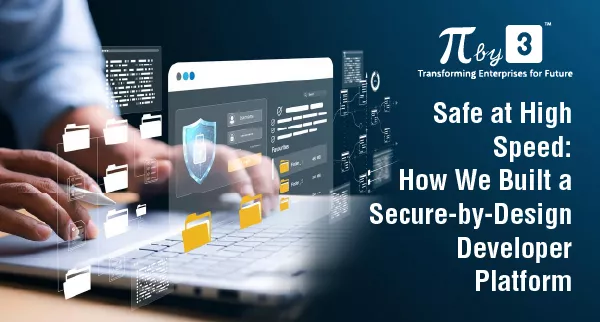
Our mandate was clear: design a centralized developer platform a structured pathway that accelerates code from local development environments to production infrastructure without compromising governance.
By architecting an integrated solution combining Azure DevOps for orchestration and AWS for global distribution, we established continuous pipelines where security operates as embedded intelligence rather than external validation. We implemented shift-left principles, integrating scanning mechanisms Snyk for dependency analysis, Trivy for container security, and SonarQube for code quality directly within the development lifecycle. This approach identifies vulnerabilities during active development, significantly reducing remediation costs compared to post-deployment fixes.
The Technology Behind the Transformation
Our solution leveraged targeted capabilities across platforms to establish operational excellence:
- Orchestration Layer: Azure DevOps Repos & Pipelines centralized version control and automated workflow execution
- Distribution Infrastructure: AWS S3 & Amazon CloudFront scalable storage and edge-optimized content delivery
- Security Automation: Trivy, Snyk, and SonarQube continuous scanning integrated at every pipeline stage
Real-World Impact
The transformation delivered measurable improvements across the development lifecycle:
- Faster Deployment Cycles: Automated pipelines accelerated the journey from ideation to production. Teams moved from manual, error-prone releases to streamlined, repeatable deployments that reduced time-to-market.
- Enhanced Security Posture: Significant reduction in production vulnerabilities through automated pre-commit scanning. Security became a proactive measure embedded in the workflow, not a reactive checkpoint that delayed releases.
- Improved Code Quality: Consistent compliance with quality gates through automated enforcement. Every commit now passes through standardized checks, ensuring maintainable, reliable code reaches production.
- Better Developer Experience: Reduced manual intervention, enabling teams to focus on feature development rather than toolchain management. Developers reclaimed hours previously spent navigating fragmented systems and coordination overhead.
- Faster Recovery: Substantially decreased incident response and resolution times. Automated rollback capabilities and comprehensive logging enabled teams to identify and address issues before they escalated.
This platform eliminated the traditional trade-off between speed and security. By establishing automated governance as foundational infrastructure, the organization achieved simultaneous gains in velocity, quality, and compliance demonstrating that properly architected systems create competitive advantages rather than constraints.