Every decade, something reshapes how enterprises think about technology.
ERPs in the 90s. Cloud in the 2000s. Data platforms in the 2010s.
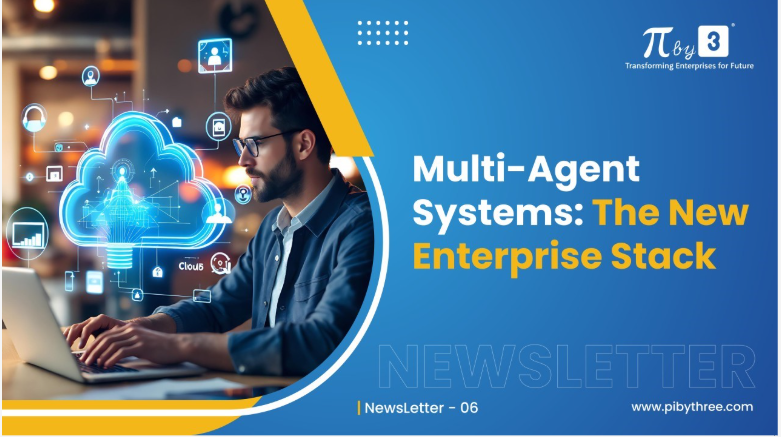
We are at the start of the next one. This time, it is agents .
Not chatbots. Not copilots.
Autonomous, goal directed AI agents that collaborate with one another to plan, act, and deliver outcomes across your entire operation.
What actually changed?
The first wave of enterprise AI was a smarter search box. Ask, get an answer. Useful. Limited.
Multi-agent systems work differently.
One agent researches. One writes. One validates. One routes the output to the right system. A coordinator oversees all of them. No human managing the queue.
The result?
𝟯× faster workflow completion vs. single-model setups
𝟲𝟬% fewer human handoffs in complex enterprise processes
𝟰𝟬% lower AI operational cost through task-specific routing
Where it is already delivering?
🏦 Finance and Compliance
Agents that ingest documents, cross-reference policy, flag anomalies, and generate audit-ready reports. Zero human touch on routine cases.
🛒 Supply Chains and Operations
Multi-agent coordination across procurement, inventory, and logistics. Disruptions caught before they escalate.
🧬 Healthcare and Pharma
Clinical agents analyzing patient data, matching trial criteria, summarizing findings. Research timelines compressed dramatically.
🎯 Sales and CRM
Agents that qualify leads, research prospects, draft outreach, and update CRM records. Triggered by a single signal from your data pipeline.
Why most enterprise projects never ship?
The pilot impressed everyone in the boardroom. Then nothing shipped.
Same reasons, every time.
- Data foundations are not production ready.
- Agent outputs that could not be audited or traced.
- No governance layer for hallucinations or model updates.
- Cloud costs nobody planned for at volumes.
This is exactly what we built our accelerator suite to solve at 𝗣𝗶𝗯𝘆𝗧𝗵𝗿𝗲𝗲.
π-Ingest · Turbo-π · Maestro-π · π-Recon · π-QLens · π-LangEval · π-FinOps
Purpose-built. Not wrappers. Not demos. Engineering that gets agents to production and keeps them reliable once they are there.
Three signals we are watching right now
1.Agent-to-agent protocols are becoming standard.
Enterprises building on closed, proprietary agent implementations today will face painful migration work within 18 months.
2.Memory and context management are next hard problem.
Organizations that get this right will have a structural advantage in agent reliability.
3. Evaluation is becoming a competitive differentiator.
Knowing whether your agents are performing correctly, not just running, is where the serious work is happening.
The question is no longer whether AI can reason.
It is whether your infrastructure can support agents that reason together at enterprise scale, with governance you trust.
If you are navigating this, we would like to talk.
👉 Explore GenAI-in-a-Box 2.0: genaiinabox.ai
👉 Talk to our team: pibythree.com/contact-us