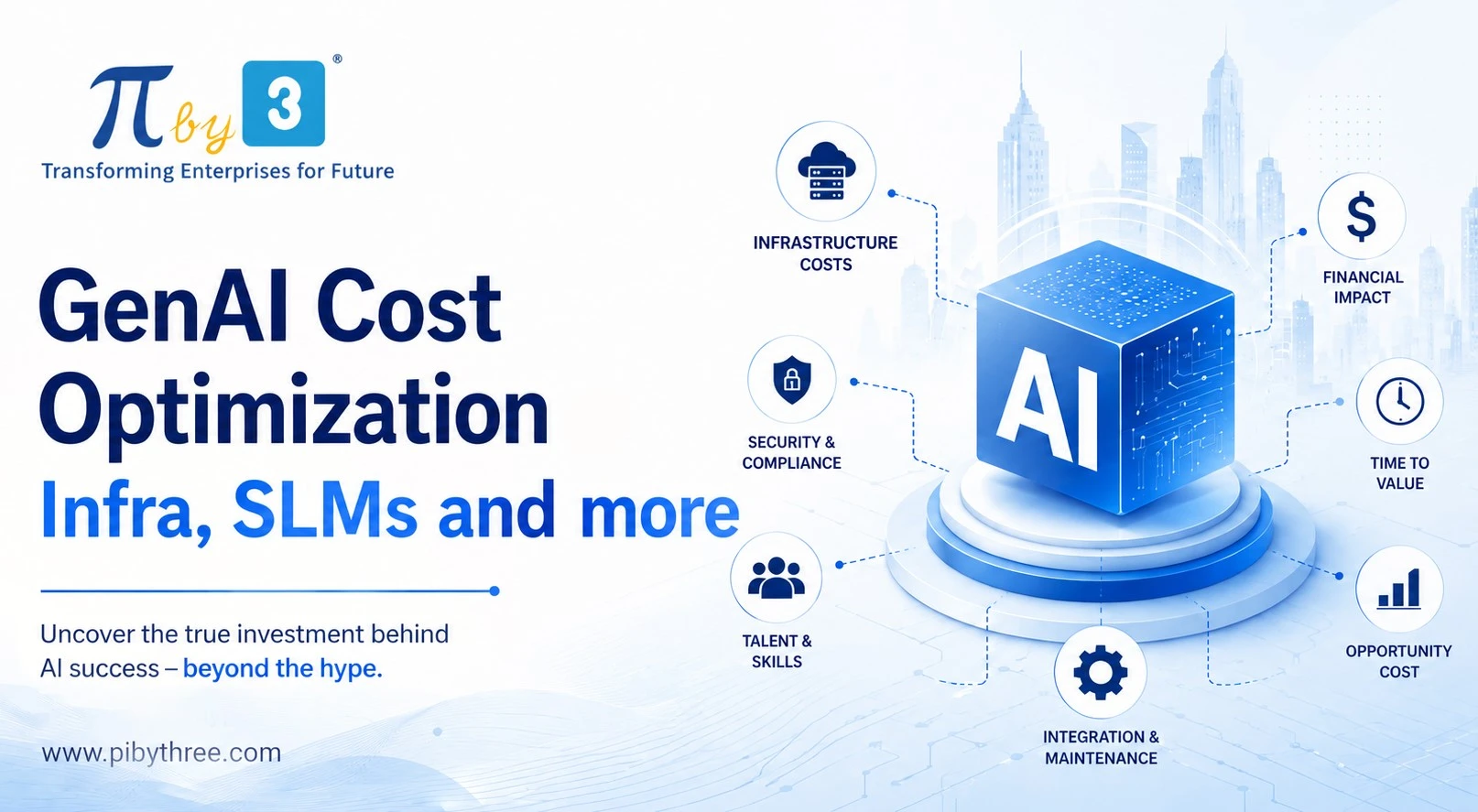
GenAI Cost Optimization - Infra, SLMs and more
Let me tell you something nobody warns you about when you move from building AI for clients to running it yourself.
When you're in consulting, the client pays the bill. Simple. But the moment you're operating the service? Every cost in the stack is yours. And that changes everything about how you think.
You stop asking "can we use GenAI for this?" and start asking "how do we engineer this, so it doesn't bankrupt us in production?"
Here's what I mean. The cost stack people actually see in production looks like this:
✦ Governance — Access control, policy enforcement, audit trails. I know it sounds boring. But in an enterprise deployment, this is a full system you have to build and run. It's not a checkbox.
✦ Guardrails — Safety filters, output validation, boundary checks across every single agent interaction. These aren't one-time setups. They run continuously. Every request.
✦ Observability — If you can't see what every model, every agent, every pipeline is doing in real time, you're flying blind. Production without observability isn't brave. It's reckless.
✦ Evaluation — Here's the thing about LLMs: they're non-deterministic. What passes your tests today drifts in production next week. Continuous evaluation isn't optional. It's what keeps the whole thing honest.
Most teams I talk to only see the token bill. The real spend is everything holding the system together around it.
─────────────────────────
So once you own the full stack, how do you engineer the cost down? Here's what we do:
LLMs → Quantization: Strip parameters, shrink the model footprint. For most production tasks, you genuinely don't need every weight.
GPUs → CPUs: GPUs are for training. For inference at scale, horizontal CPU deployments handle the load at a fraction of the cost. Most teams massively overprovision here, I've seen it.
LLMs → SLMs: This is the biggest lever. A small language model handles classification, extraction, summarisation, doc Q&A, for far less. The principle is simple: match the model to the task, don't default to the biggest one.
Stack these together and your cost becomes predictable by design. Not a nasty surprise at month-end.
─────────────────────────
One last thing, and I say this from experience.
Even a well-optimised system can quietly go wrong. Hallucinations don't announce themselves. Agent decisions become untraceable. RAG pipelines degrade over time. Responses drift from what you tested.
At enterprise scale, these aren't edge cases. They're operational risk.
Own the full stack. Understand every layer. Engineer it deliberately. That's the job now.