4.5 billion. That's how much enterprise cloud infrastructure spend will be wasted in 2025 on underutilised, idle or misconfigured resources. And that's just the waste we can measure.
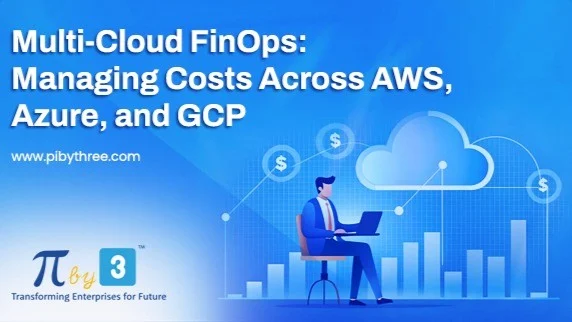
For CTOs and CIOs running multi-cloud environments, the promise of flexibility across AWS, Azure, and GCP comes with a quiet tax: complexity. Over 67% of enterprises now operate across two or more cloud providers yet only 39% track unified cloud spend accurately. You're paying for scale you can't see and governance you haven't built yet.
This is the FinOps problem. And it's no longer just an IT concern it’s a board-level conversation.
"Cloud efficiency isn't just a numbers game it's about creating a culture of cost awareness where every architectural decision has a financial consequence."
Why Multi-Cloud Makes Cost Governance Hard
Each cloud provider prices differently. AWS charges per second. Azure bundles licensing. GCP rewards sustained usage. Comparing them without a standardised cost model is like reading three different currencies without an exchange rate.
89% of organisations report that lack of cloud cost visibility directly impacts their ability to manage spend effectively. Add in shadow IT, ungoverned workloads, and untagged resources and your cloud bill becomes a moving target that no dashboard can catch in real time.
It takes the average enterprise 31 days to identify and eliminate cloud waste and another 25 days to detect and right size overprovisioned resources. By that time, the next sprint has already provisioned more.
The Three Levers CTOs Must Pull
- Unified Cost Visibility You cannot govern what you cannot see. A single pane of glass across AWS, Azure, and GCP with consistent tagging, chargeback models, and anomaly alerts is the baseline, not the bonus.
- FinOps-Embedded Engineering 52% of engineering leaders say the disconnect between FinOps and development teams is the primary driver of wasted cloud spend. Cost awareness must shift left into architecture reviews, not just post-deployment audits.
- Automation Over Aspiration Automated cost governance tools can save enterprises up to 20% annually through real-time rightsizing and de-provisioning. Manual reviews don't scale at cloud speed. Automation does.
What πby3 Has Done
AWS Cost Optimisation for a Solar Plant Operator A solar major running IoT data workloads on AWS had architecture debt quietly draining their infrastructure budget. πby3 replaced MongoDB with Snowflake, swapped inefficient CRON jobs with Apache NiFi, and introduced Kafka for real-time streaming cutting EC2 costs by ~63% and S3 costs by ~75%.
Data Engineering & ML Cost Reduction for a Pharma Major A pharma client's AWS-hosted ML platform was overprovisioned and under monitored. πby3 rebuilt the architecture on Snowflake + Dataiku, converted KNIME workflows to Python, and instrumented cost monitoring via Datadog achieving a ~70% reduction in Lambda costs and 200% reduction in vCPU consumption.
In both cases, the fix wasn't just technical. It was a FinOps mindset applied to engineering decisions before, during, and after deployment.
The πby3 FinOps Approach
We don't hand you a dashboard and walk away. We embed FinOps discipline into your cloud architecture itself through:
- Right-sized infrastructure design across AWS, Azure, and GCP
- Cost monitoring pipelines using tools like Datadog, native cloud cost explorers, and custom alerting
- FinOps-aligned data platform migrations that eliminate redundant processing at the source
- Pipeline automation that removes the manual overhead that quietly inflates cloud bills
FinOps maturity programs have reduced cloud waste by up to 40% in early adopters. The organisations getting there fastest are the ones treating FinOps as an engineering discipline not a finance report.
The CTO's Takeaway
Multi-cloud was never supposed to mean multi-cost. If your infrastructure sprawl has outpaced your governance model, the answer isn't a new cloud provider it's a sharper operating model for the ones you already have.
πby3 helps technology leaders turn cloud complexity into cost clarity across every provider, every workload, every sprint.
🔗 Explore how we do it: www.pibythree.com