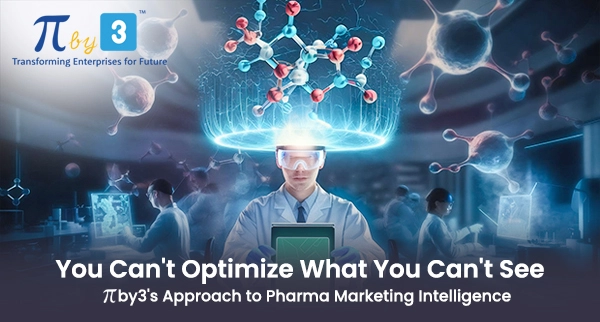
πby3's Approach to Pharma Marketing Intelligence
In 2026, life sciences marketing has a data problem not a shortage of it, but an excess of it in all the wrong places. The sector spans Pharmaceuticals, Biologics & Biotech, Medical Devices, Diagnostics, Genomics, and Contract Research Organizations (CROs) each generating its own streams of campaign data, field intelligence, and engagement signals, with no unified view to connect them.
Campaign data sits across digital platforms, field force programs, Key Opinion Leader engagement, and clinical education initiatives. Device performance lives in one report, biologics Healthcare Professional (HCP) engagement in another, diagnostics spend in a spreadsheet someone emailed last Tuesday. The result: decisions get made on instinct dressed up as analysis and marketing spend flows toward channels that feel effective rather than channels that demonstrably are.
This is not a minor operational inconvenience. Life sciences marketing spanning pharma, medtech, diagnostics, and biotech accounts for tens of billions annually in the US alone. When visibility is fragmented, even a modest misallocation is a measurable loss. The industry has known this for years. What it has lacked is a clean architecture to fix it.
The Measurement Gap Is Widening
The pressure on Life Sciences marketers in 2026 is acute. Stricter privacy standards, signal loss across digital channels, and rising accountability demands are pushing the industry away from last-click attribution and fragmented dashboards toward modelled outcomes and predictive analytics.
The opportunity, however, is equally clear. AI is now delivering predictive marketing analytics that help life sciences companies whether launching a new diagnostic, a therapeutic device, or a specialty drug forecast campaign impact before spending is committed, and prescriptive insights that recommend specific actions to maximize ROI.
The gap between organizations that have built this capability and those still working from quarterly slide decks is widening, fast. Leaders are running always-on marketing mix analysis, measuring omnichannel synergy across HCP, patient, and payer segments, and dynamically reallocating budgets based on real-time performance.
What πby3 Built
When a life sciences organization approached πby3, the problem was structural: campaign data distributed across digital, field force, and medical education channels with no unified view making consolidation complex, performance tracking inconsistent, and budget decisions reactive rather than strategic.
πby3 designed and delivered a four-layer analytics architecture built on Snowflake, Informatica, and Tableau.
Centralized Data Consolidation came first integrating multi-source marketing data into a unified cloud-based analytics platform. This alone eliminated the primary bottleneck: the inability to ask a single question across all channels simultaneously.
Advanced Campaign Analytics built on that foundation, enabling region-wise, channel-wise, and HCP-level performance insights. For the first time, the client could compare what was working in one geography against another and understand why.
Automated Data Quality & Processing ensured insights were trustworthy validation and automation baked into the pipeline so reporting cycles accelerated without sacrificing accuracy.
Interactive Visualization via Tableau closed the loop for leadership dynamic dashboards delivering real-time, actionable insights rather than periodic summaries that arrived too late to change anything.
The Business Outcomes
The impact was direct and measurable across five dimensions:
- Improved ROI Visibility: accurate, channel-wise measurement replaced guesswork
- Optimized Marketing Spend: budgets reallocated toward high-performing channels and segments based on evidence
- Faster Insight Generation: reporting cycles shortened through automation and centralized analytics
- Enhanced Campaign Effectiveness: data-driven targeting improved engagement across HCP and stakeholder segments
- Strategic Decision Enablement: leadership gained real-time visibility for smarter commercial planning
Early adopters of advanced AI analytics for campaign optimization report approximately 20% improvement in marketing ROI. πby3's architecture makes that number accessible to commercial teams across pharma, medtech, diagnostics, or biotech without requiring a data science overhaul.
The Principle at the Centre
Predictive analytics and AI enable pharma and biopharma teams to anticipate prescribing trends, support data-driven decision-making, identify high-value HCPs, optimize channel investments, and respond to market shifts before performance gaps emerge.
But none of that is possible when the underlying data remains fragmented.
πby3's work here was not about layering more analytics on top of an existing mess. It was about resolving the foundational architecture first so that every insight built on it would hold.
In a market where budgets face increasing scrutiny and performance expectations are rising across every life science vertical, the organizations that will lead are those that can see clearly.
That is precisely what this engagement delivered.
πby3 is an IT consulting firm specializing in AI-powered and data-driven solutions for enterprise operations. To explore how centralized analytics can sharpen your commercial strategy across life sciences, connect with our team.