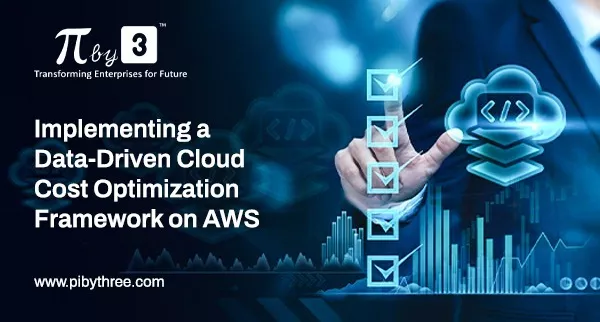
Shifting from Reactive to Proactive Cloud Financial Management
Cloud bills are rarely wrong but without the right lens, they rarely tell the full truth either.
This engagement transformed a traditional, reactive approach to cloud spending into a continuous, data-driven discipline. Rather than a one-time cost-cutting exercise, the focus was on identifying structural inefficiencies within the AWS environment, implementing high-impact technical adjustments, and embedding governance to prevent future cost regression.
Industry Challenges
Modern enterprises frequently encounter a combination of Cloud complexities and Over-Provisioning. The key friction points:
- Provisioning for Peaks: Engineering teams provision resources against hypothetical peak loads not actual consumption leaving significant idle capacity running at full cost.
- Unmanaged Data Growth: Automated processes and backups generate accumulated data with no expiration date and no lifecycle strategy, creating persistent and avoidable storage costs.
- Lack of Visibility: Without granular analytics, organizations struggle to connect technical resource usage to financial accountability.
- Cost Regression: Even after periodic cleanups, costs climb back up as new, unoptimized workloads are deployed without governance guardrails.
The Approach: Analyse, Optimize, Govern
The engagement operated on a three-pillar strategy designed to deliver both immediate savings and long-term fiscal discipline.
Analyse AWS Cost Explorer and service-level analytics were used to map spending against actual demand. The finding was clear: workloads provisioned conservatively led to sustained overconsumption during standard operations effectively paying peak prices for average workloads.
Optimize Object Storage (S3) emerged as a primary cost driver. Using S3 Storage Lens, the team identified significant spend originating from non-current data versions and stale operational artifacts. Lifecycle-aware policies were applied to automatically transition data to lower-cost tiers or remove it entirely a structural fix, not a one-time cleanup.
Govern Technical fixes without governance are temporary. Standards for resource ownership and data retention were introduced, ensuring cost-awareness is built into the design phase of every new infrastructure deployment not addressed after the invoice arrives.
Technologies Used
- AWS Cost Explorer: High-level spend analysis and trend forecasting
- S3 Storage Lens: Granular visibility into object storage usage with actionable cost-saving recommendations
- AWS Lifecycle Policies: Automated transition and expiration of data across storage tiers
- Service-Level Usage Analytics: Correlating resource performance with actual business demand
- Tagging & Governance Frameworks: Enforcing resource ownership and accountability at scale
S3 Lifecycle Strategy & Cost Impact
| Storage Class | Use Case | Lifecycle Action | Cost Impact |
|---|---|---|---|
| S3 Standard | Active logs & operational data (<30 days) | Immediate access | Baseline cost |
| S3 Standard-IA | Infrequently accessed data (e.g., monthly reports) | Move after 30 days | ~40% savings |
| S3 Glacier Instant Retrieval | Archival data needing millisecond access | Move after 90 days | ~68% savings |
| S3 Glacier Deep Archive | Compliance/legal hold data (7–10-year retention) | Move after 180 days | ~95% savings |
| Non-Current Versions | Previous versions of edited files | Delete after 30–90 days | High overhead reduction |
| Incomplete Multipart Uploads | Failed file uploads (hidden storage) | Delete after 7 days | Direct overhead removal |
The Transformation: Before vs. After
| Dimension | Reactive State | Optimized State |
|---|---|---|
| Strategy | One-time cost-cutting exercises | Continuous, data-driven discipline |
| Provisioning | Conservative peak-load buffering | Rightsized to actual business demand |
| Data Growth | Unmanaged, accumulated storage overhead | Lifecycle-aware automated tiering |
| Visibility | Monthly invoice surprises | Granular tracking via S3 Storage Lens |
| Governance | Corrective & manual | Preventive & policy-driven |
Impact Created
- Improved Financial Efficiency: Immediate and sustainable reduction in monthly cloud spend by aligning capacity with real-time business demand.
- Elimination of Overhead: Significantly reduced storage costs by addressing accumulated non-current data and redundant operational artifacts.
- Operational Resilience: Cost optimization achieved without compromising application availability or compliance standards.
- Repeatable Framework: The organization moved from a corrective mindset to a preventative one with standards designed to scale.
- Design-Phase Savings: New workloads are now deployed using cost-aware patterns, eliminating unexpected cost escalations before they occur.
Cloud cost optimization is not a project with a finish line it is an operational capability.
By combining deep technical analysis with rigorous governance, this engagement demonstrated that Cloud Financial Management (FinOps) is not a back-office expense. With the right data and a disciplined framework, it becomes a genuine competitive advantage.
“With the right data and a disciplined framework, FinOps becomes a competitive advantage not a cost centre.”