From Always-On to Demand-Aligned: Implementing a Data-Driven Cost Optimization Framework for a QlikSense Analytics Platform
Turning Infrastructure Insights into Sustainable Cost Optimization
Overview
Enterprise analytics platforms are built for reliability but reliability, when left unexamined, quietly becomes inefficiency.
This initiative focused on improving infrastructure efficiency for a QlikSense analytics platform operating across multiple environments. Over time, conservative provisioning strategies designed to protect performance had resulted in persistently underutilized compute resources and steadily inflated infrastructure and licensing costs.
Rather than executing a one-time cost reduction exercise, the engagement focused on identifying structural inefficiencies, implementing targeted infrastructure optimizations, and aligning platform capacity with actual workload demand while maintaining the same level of system performance throughout.
Industry Challenges
Enterprise analytics platforms frequently develop inefficiencies as environments scale. The most common contributing factors include:
| Always-On Infrastructure | Provisioning for Peak Demand | Licensing Cost Expansion | Limited Infrastructure Visibility |
| Systems supporting multiple environments remain active continuously, even during periods of little or no user activity accruing cost with no corresponding business value. | Infrastructure is routinely sized for theoretical peak scenarios rather than actual usage patterns, resulting in persistent over-provisioning and significant idle capacity. | Operating system licensing models that scale with CPU cores can substantially increase costs when infrastructure configurations are not carefully aligned with workload requirements. | Without continuous workload analysis, infrastructure configurations remain unchanged even as platform usage evolves making inefficiencies invisible until they surface on an invoice. |
Technologies Used
- QlikSense Platform: Enterprise analytics platform for interactive dashboards and data analysis
- Cloud Compute Infrastructure: Virtualized compute environment supporting application services and data processing workloads
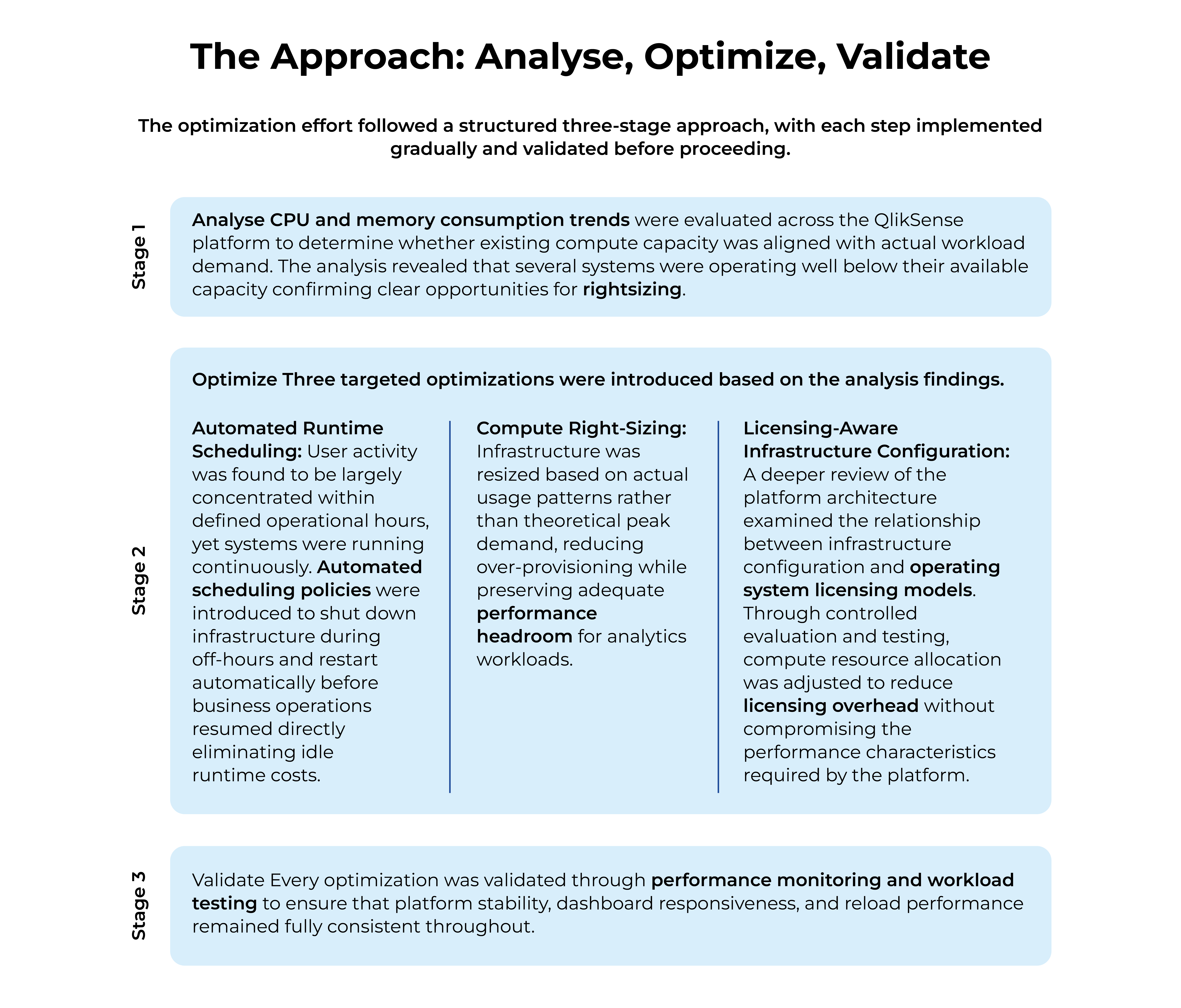
- Infrastructure Scheduling Automation: Automated runtime management aligning infrastructure availability with operational demand
- Workload Utilization Analysis: Continuous monitoring of CPU and memory patterns to determine optimal compute sizing
- Operating System Licensing Optimization: Configuration adjustments designed to align compute architecture with licensing models and reduce overhead
Impact Created
- Improved Infrastructure Efficiency: Compute resources were aligned with real workload patterns, significantly reducing unused capacity across the platform environment.
- Reduction in Idle Infrastructure Costs: Automated scheduling eliminated unnecessary runtime outside operational hours delivering an estimated ~37% reduction in non-production compute cost.
- Optimized Compute Provisioning: Right-sizing adjustments reduced over-provisioning while maintaining adequate performance headroom for all analytics workloads.
- Reduced Licensing Overhead: Infrastructure configuration changes delivered an estimated ~50% reduction in operating system licensing cost one of the most significant savings levers identified in the engagement.
- Maintained Platform Performance: All optimizations were validated through structured testing to confirm that platform responsiveness, dashboard load times, and reload performance remained unchanged throughout.
Conclusion
Infrastructure efficiency in analytics platforms is rarely limited by technical capability it is limited by the absence of a structured, evidence-based approach to evaluating what is running and why.
By combining automated runtime scheduling, compute right-sizing and licensing-aware infrastructure configuration, the QlikSense platform transitioned from a static, always-on architecture to a more efficient, demand-aligned operating model without any compromise to application performance or user experience.
This engagement reinforced a fundamental principle of Cloud FinOps: effective cost optimization is not about reducing capacity. It is about ensuring that every unit of infrastructure is configured and utilized in the most efficient way possible.
"The most expensive infrastructure is not the infrastructure you use it is the infrastructure you forget is running."