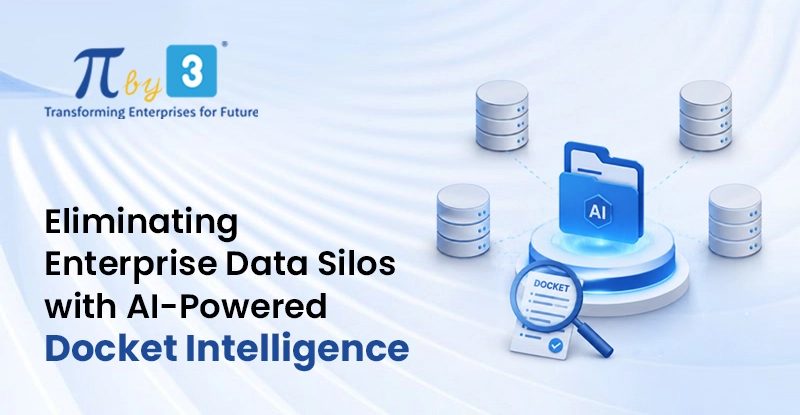
Docket Generation for AI/ML Consulting Tech firm | Agentic AI & RAG Case Study
Reference-Based Context Assembly · SLM Population · Docket Publishing · Grounded Search
From fragmented data silos to a single AI-assembled docket traceable, reviewable, and publishable in minutes.
01 | OVERVIEW
The Enterprise Intelligence Gap
Modern enterprises operate across interconnected domains Sales, Manufacturing, Quality, Procurement, and CRM, yet the data that binds these domains together remains stubbornly fragmented. When a business event triggers an investigation, analysts must manually traverse multiple systems, stitching records by hand, often with no single assembly point and no guarantee of completeness.
Consulting Tech recognized this pattern as a systemic bottleneck. Business analysts, operational investigators, quality reviewers, and customer operations teams were spending disproportionate time on data gathering rather than decision-making. A reference number whether an order ID, a batch number, or a CRM case should be all it takes to surface the full picture. Instead, each investigation started from scratch, consumed hours across tools, and produced outputs that lacked source traceability or consistent structure.
Docket Consulting Tech was conceived to prove that an AI-orchestrated system could change this fundamentally. By combining an Agentic AI orchestration layer, a Small Language Model (SLM), a structured Human-in-the-Loop (HITL) workflow, and a governed docket publishing pipeline, Consulting Tech set out to demonstrate that one reference number is enough to trigger automated cross-domain context assembly, AI-powered summarization, and a traceable, reviewer-approved docket all within a single governed workflow.
02 | CHALLENGES
What Was Holding the Business Back
Business Challenges
| Challenge | Business Consequence |
| No Unified Reference View | Data related to a single business reference order, batch, case was siloed across Sales, Manufacturing, Quality, Procurement, and CRM with no single assembly point, forcing analysts to context-switch across multiple tools for every investigation. |
| Manual Dossier Assembly | Analysts stitched records by hand across systems, a process that consumed hours per investigation, introduced human error, and created inconsistent outputs with no audit trail. |
| No Targeted Search Capability | Investigators had no way to ask questions scoped to a single reference, making it impossible to rapidly verify linkages, exceptions, or status without broad, imprecise searches. |
| Poor Source Traceability | Conclusions drawn from assembled data could not be reliably traced back to source records, undermining trust in the output and creating compliance risk for regulated decisions. |
| Inconsistent Investigation Structure | Every investigation started from scratch no standard dossier format, no common domain taxonomy, and no repeatable process for review and approval before decisions were communicated. |
Technical Challenges
| Challenge | Technical Consequence |
| Multi-Hop Entity Resolution | A single reference number links to entities across domains through indirect relationships Reference → Delivery → Batch → Component Lot → Supplier PO. Resolving these joins reliably across a heterogeneous Data Lake required a purpose-built entity resolution layer. |
| Cross-Domain Data Normalization | Retrieving data from five structurally different domain contexts and normalizing it into a coherent, evidence-tagged Context Package required domain-aware adapters and a correlation layer capable of scoring join confidence. |
| SLM Grounding Without Hallucination | Invoking a language model over business-critical data without risk of fabricated identifiers, inferred lot numbers, or unsupported conclusions required strict retrieval-first architecture and mandatory guardrails preventing any inference beyond retrieved data. |
| HITL Workflow Enforcement | Preventing auto-publication of AI-generated dockets and ensuring every output passed through a structured human review, revision, and approval cycle required a stateful workflow engine with full audit logging at every stage. |
03 | THE SOLUTION
Reference-Based Agentic Intelligence End to End
The Docket CONSULTING Tech was designed around a core architectural principle: Retrieval-First, SLM-Second. The system retrieves structured data before invoking the language model. The model reasons only over already-retrieved, reference-scoped data it does not search, guess, or fabricate. This principle underpins every capability below.
Reference Intake & Validation
A clean, mail-style intake screen accepts a reference number as the primary input, with an optional free-text note for additional context. The Intake Agent validates format, creates a session and request ID, and routes the request to the orchestrator. This single action initiates the full cross-domain context assembly lifecycle no manual steps required.
Seven-Agent Orchestration Architecture
The Agent AI Orchestrator acts as the control tower, coordinating seven specialized agents across the full request lifecycle:
- Intake Agent: validates the reference and initiates the request context
- Retrieval Agent: resolves linked records and queries all five domain retrieval services
- Correlation Agent: merges domain outputs, normalizes structure, builds the Reference Context Package, scores join confidence, and surfaces unresolved gaps
- SLM Invocation Agent: prepares constrained prompts, calls the SLM, validates structured output, and stores results
- Docket Agent: generates the draft docket from SLM outputs and evidence, managing draft states from creation through to publication
- Query Agent: answers free-form questions scoped strictly to the active reference, with evidence attribution per answer
- Workflow Agent (HITL): routes drafts to reviewers, manages approval stages, handles revision cycles, and logs the complete approval chain
Five-Domain Context Assembly
Every reference retrieval spans Sales, Manufacturing, Quality, Procurement, and CRM assembled into a unified, evidence-tagged Reference Context Package. Multi-hop entity resolution traverses indirect relationships across domains automatically. Missing data is surfaced explicitly; no domain is ever silently omitted. This enabled investigators to see the full reference picture in one place, not reconstructed across five tools.
SLM-Powered Summarization and Anomaly Detection
The Small Language Model operates over the pre-assembled Context Package — never raw Data Lake tables. It executes four scoped sub-tasks: per-domain summarization with evidence links; cross-domain correlation and anomaly detection; docket section composition; and grounded Q&A responses. Mandatory guardrails prevent hallucinated identifiers, unsupported inferences, or out-of-scope conclusions. Every output maps to a specific evidence record.
Human-in-the-Loop Docket Review and Publication
No docket is ever auto published. Every output enters a six-stage HITL workflow: Draft Generated → Review Queue → Reviewer Action (Approve / Reject / Revise) → Rework Loop (targeted section re-run) → Final Approval → Publish. Reviewers receive the draft docket, evidence register, missing data list, anomaly flags, and confidence indicators. The full approval chain with timestamps, roles, and actions is written to an immutable audit log.
Grounded Free-Form Query
After context assembly, users can ask any natural language question against the active reference without re-entering the reference number or starting a new session. The Query Agent restricts answers strictly to reference-linked data, surfaces supporting source record identifiers with every response, and explicitly refuses out-of-scope requests enabling rapid, traceable investigation without risking data contamination from unrelated records.
04 | IMPACT CREATED
Outcomes Delivered
- Cross-Domain Context Assembly in One Workflow : What previously required analysts to traverse five separate systems and stitch records by hand is now triggered by a single reference number — with automated retrieval, normalization, and SLM summarization completing the full context package without manual intervention.
- Zero Silent Data Gaps : Every missing domain record is surfaced explicitly. The system never omits a gap — it marks it, routes it to the reviewer with an anomaly flag, and prevents publication until the reviewer makes a conscious decision about it. Investigators no longer proceed on incomplete information without knowing it.
- Traceable Conclusions from Every Fact : Source attribution is embedded at every layer from Data Lake retrieval through SLM output to the published docket. Every displayed fact carries its source system, object type, record ID, and timestamp. Audit reviewers can trace any docket statement back to its exact origin record.
- Governed, Human-Approved Publication Pipeline : The mandatory HITL workflow ensures no AI-generated content reaches a compliance, customer, or management audience without a complete human review. The revision loop targeted to affected sections only eliminates the need to regenerate the entire docket for small corrections.
- Scalable Extensibility Without Redesign : The seven-agent architecture is independently extensible. A new domain context Finance, Logistics, or any other — can be added without modifying the core orchestrator. New approval stages, decision policies, and reference types are configurable without code changes.
| QUANTIFIED BUSINESS VALUE |
| Investigation time per reference Reduced from multi-hour manual assembly to sub-15-second first response on dataset |
| Source traceability coverage 100% every docket fact carries source system, record ID, and timestamp |
| Manual stitching eliminated All five domain contexts assembled automatically from a single reference number input |
| Human oversight maintained Zero auto-published dockets 100% of outputs pass through mandatory HITL review |
| Audit trail completeness Full request lifecycle logged from intake through publication with immutable, quarriable records |
05 | TRANSFORMATION SNAPSHOT
Before vs. After: The Investigation Workflow
| BEFORE | AFTER |
| Analysts manually traverse 5+ systems for every reference investigation | One reference number trigger automated retrieval across all 5 domain contexts |
| Records stitched by hand — no standard structure, no audit trail | SLM assembles a normalized, evidence-tagged Context Package automatically |
| Missing data goes undetected until a decision is already made | Every missing domain record is flagged explicitly; reviewer decides how to proceed |
| Questions answered from memory or ad-hoc searches — no source attribution | Grounded Q&A against active reference data — every answer cites source records |
| Dockets assembled in document editors; no governed review process | Structured dockets generated from SLM output; published only after HITL approval |
| Every investigation starts from scratch regardless of reference type | Reusable agent architecture supports any reference type without redesign |
| Compliance risk from untraceable conclusions and informal approvals | Full audit log from intake to publication; every fact traceable to source record |
06 | CONCLUSION
The Strategic Implication
The Docket Consulting Tech establishes a replicable architectural pattern for enterprise intelligence: one reference number, five domain contexts, one governed workflow, one traceable docket. It demonstrates that the bottleneck in cross-domain investigation is not data availability — the data exists in the lake — but the absence of an orchestrated, governed, retrieval-first AI layer capable of assembling, summarizing, and publishing that data with human accountability embedded at every stage.
What Consulting Tech proved is not merely a capability — it is an operating model. As the architecture extends to new domain contexts, reference types, and approval workflows, the core principle holds: AI assembles and reasons; humans decide and approve; the system remembers everything.
"The value of enterprise AI is not in answering questions it is in assembling the right context, from the right sources, with the right governance, so that humans can make better decisions faster."