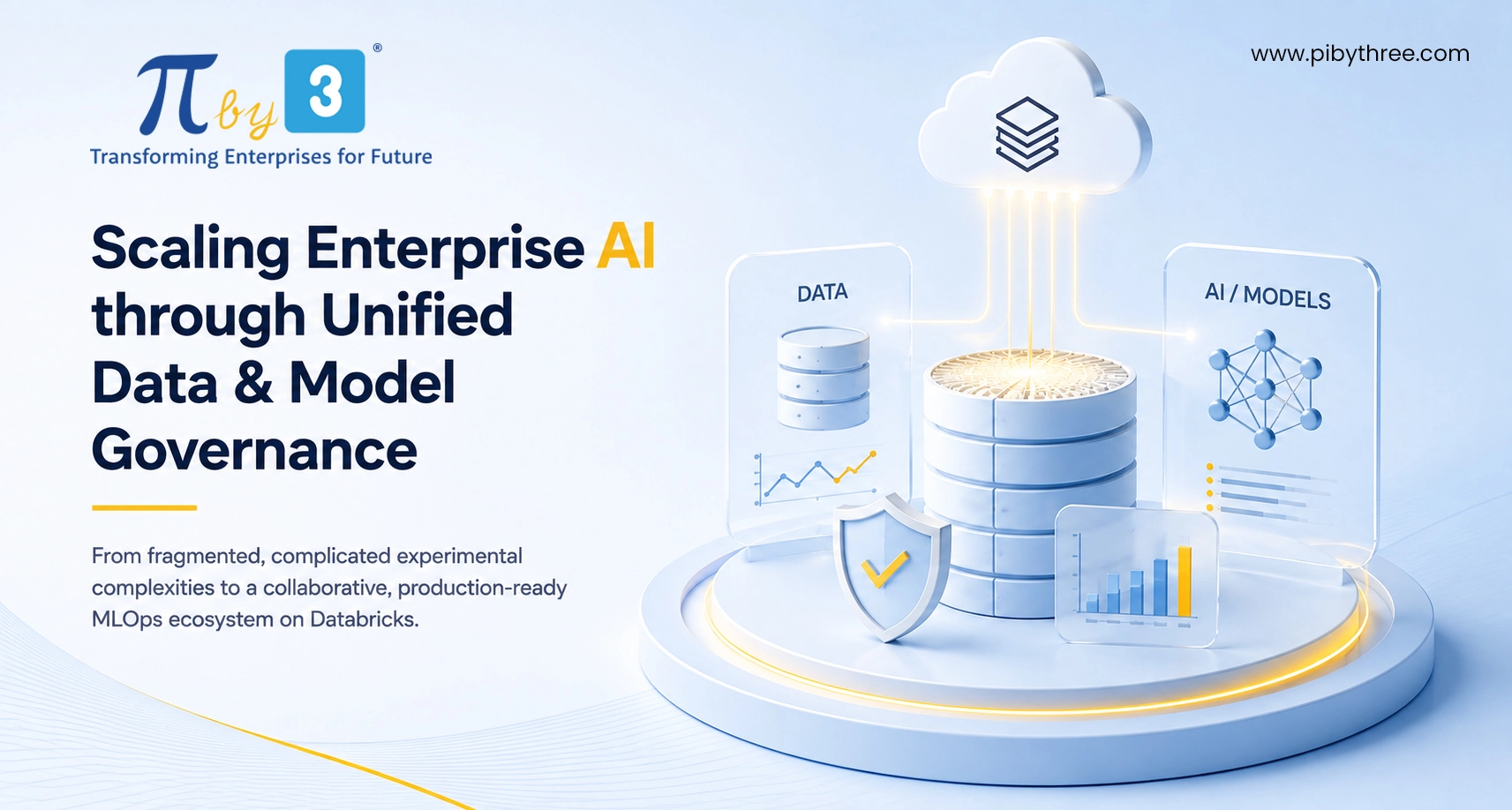
From fragmented, complicated experimental complexities to a collaborative, production-ready MLOps ecosystem on Databricks.
Overview
In the race to deploy AI, many organizations find that the biggest bottleneck isn't the algorithm, but the friction between the teams that prepare the data and the teams that build the models.
Without a shared environment, "Data" and "AI" often operate in silos, leading to "science projects" that never reach production.
Challenges
- The "Handoff" Friction
Significant delays in model deployment (often 1 to 2 months) due to manual handoffs between data engineering and data science teams. - Training-Serving Skew
Models performed well in notebooks but failed in production because the data features used for training didn't match the live production data. - Lack of Governance
No centralized way to track who used what data for which model, creating significant compliance and audit risks. - Infrastructure Overhead
Data scientists spent 40% of their time managing clusters and libraries instead of tuning models. - Fragmented Tooling
Inconsistent use of MLflow, Git, and various storage buckets led to lost experiments and "un-reproducible" results.
Solution
- Unified Governance via Unity Catalog
We implemented Unity Catalog as the "single source of truth," allowing both data and AI teams to share the same governed tables, features, and model versions. - Feature Store for Consistency
Built a collaborative Databricks Feature Store that allows data engineers to publish "production-grade" features that data scientists can consume with a single line of code. - Standardized Experimentation with MLflow
Integrated MLflow tracking across all workspaces to ensure every experiment parameters, code version, and artifacts is automatically logged and reproducible. - Automated Model CI/CD Pipelines
Created Databricks Workflows that trigger automated testing and deployment whenever a model is promoted to the "Production" stage in the Model Registry.
Impact Created
- Reduced Time-to-Market
Decreased the average model deployment cycle from 16 weeks to 2 weeks. - Eliminated Data Skew
Achieved 100% parity between training and serving data through the unified Feature Store. - Increased Productivity
Data Scientists reported a 35% increase in throughput by spending less time on infrastructure and data cleaning. - Quantified Business Value
Successfully productionized 12 high-impact models in 6 months, resulting in an estimated $2.4M in operational savings through optimized AI-driven forecasting.
Transformation Snapshot
| Feature | Before (Siloed Approach) | After (Collaborative MLOps) |
| Data Access | Manual requests/CSV exports | Direct access via Unity Catalog |
| Model Tracking | Local spreadsheets & notebooks | Automated MLflow Experiment Tracking |
| Deployment | Manual "re-coding" for production | Automated CI/CD via Model Registry |
| Team Dynamic | "Throw it over the wall" culture | Unified Data + AI pods in one workspace |
| Governance | Manual “managing model” and “data” governance | Unity Catalog removes the manual overhead of managing access control, lineage, and discovery for models and feature data |
Summary
The success of this engagement proved that MLOps is not just a technical challenge it is a collaborative one. By unifying the data and AI layers on Databricks, we moved the client from 'experimental AI' to 'industrialized AI with strong governance.